Nice is so Nice!
While we had the option of visiting other villages along the coast, like Cannes, Menton or Cagnes sur Mer, we decided to spend the last of our time here continuing to explore Nice. Again, we started our morning by walking along the Promenade des Anglais east toward La Colline du Chateau (Castle Hill). It was another nice day about 20'.


One of the things you notice as you walk along the promenade are all the bolted down rows of blue chairs. We had heard there was a history to them so I checked out the Internet and this is what I found.
Like the Tour Eiffel of Paris or Big Ben of London, la Chaise bleue has long been considered the symbol of Nice. The iconic chairs, as blue as the rippling Bay of Angels they overlook, are wedged in rows of 20 along the famous Promenade des Anglais.
Back in the 50’s, these chairs were wooden, white, and spread along the promenade. They were mostly used by families and elderly people as a place to relax. About sixty years later, the blue chair has changed its look but remains one of the Niçois’ favourite spots to relax and enjoy the view of the Mediterranean Sea.
The history of the famous chair began during the postwar period when mass tourism plummeted in the French Riviera. Charles Tordo, well-recognized inventor and worker in a maintenance company, was entrusted with the manufacture of eight hundred chairs by businessman Ballanger. As the story goes, Tordo worked overtime for weeks, with the help of his family, in order to meet Ballanger’s deadline. At that time, people would pay a small sum in exchange for the “droit de s’asseoir”or permission to sit in the chairs.
Les chaises went through a lot of change over the years and acquired a more sophisticated look; notably, they were painted a sky blue and were constructed of metal instead of wood. Since they could be easily stolen or damaged, the city council decided to remove them and stop their production in the early 2000, causing the city to lose one of its trademarks. Due to popular demand, they were back a few years later, this time secured in row of twenty.
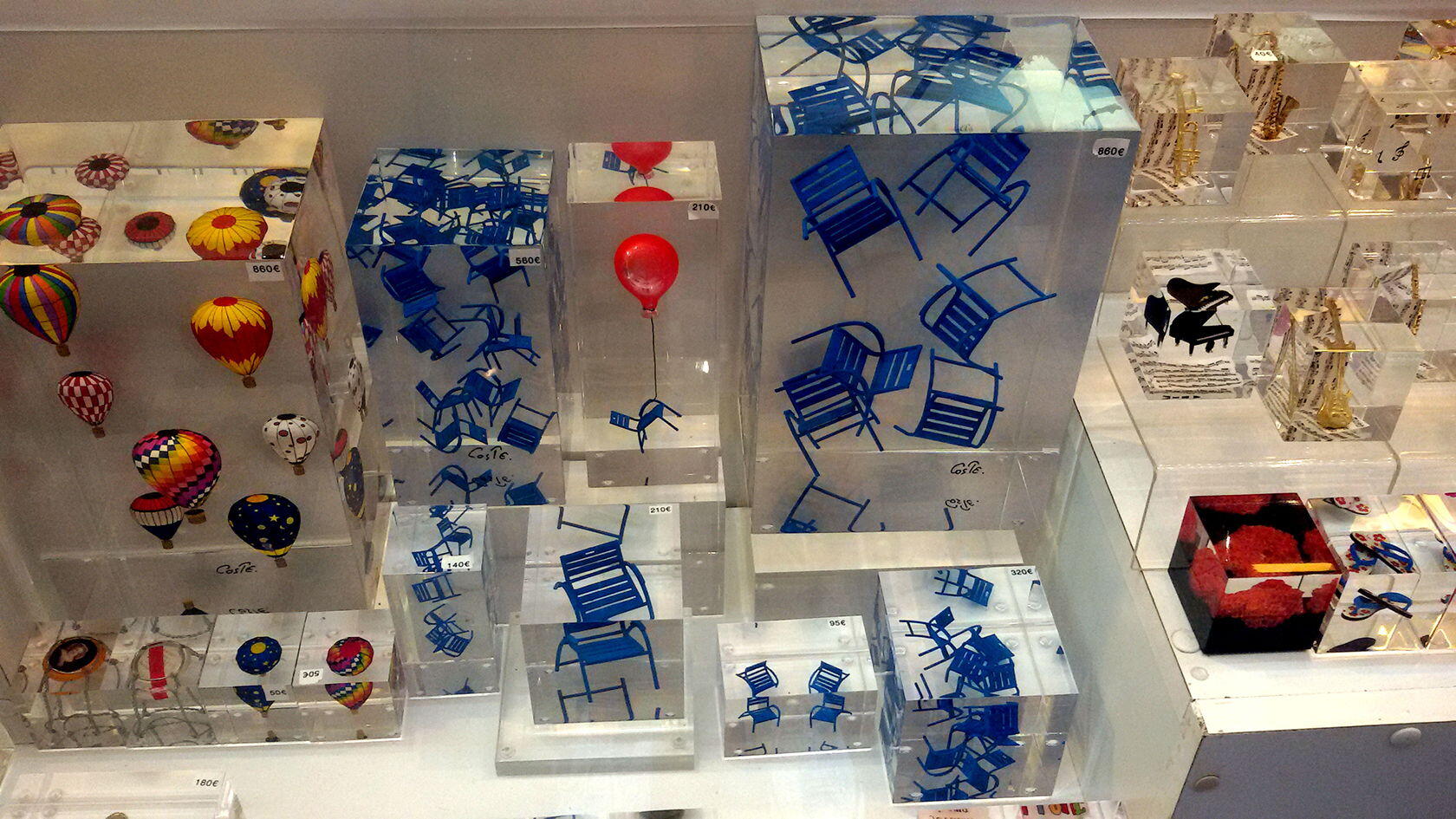
Another curious hommage to the city’s most enduring symbol are the beautiful mini blue chairs encased in acrylic that can be found at Transparence, a fancy shop in the Old Town.
We actually visited this shop later that day and talked to the wife of the owner who told us all about his work and how these pieces were created.


We continued along the Promenade to the place where the name changes to Aux Etats Unis. There is a small copy of the Statue of Liberty there and we all noticed there was a drone flying behind the statue. You can just see it to the left of the base of the statue.

The hill was inhabited from at least the 10th century BC and contact was made with the Greeks in Marseille which gave it the name Nikaia meaning "the victorious". During the middle ages the area became fortified town. In the 13th century, the lower town started to develop. From 1388, Nice belonged to the House of Savoy, a mountain state. The fortress began to be altered in the 15th C following various improvements to strengthen its defences. During the 17th C a 72 metre well was dug (called the Devil's Well) and this well allowed for the installation of an elevator shaft in 1952 which is still in operation today. Following its tumultuous history, today it has gardens, playgrounds and a waterfall that was built in the late 1800s.
We spent time wandering around the hill taking lots of photos before we took the elevator back down.
 |
| The view toward Mont Boron between Nice and Villefranche sur Mer |

 |
| The view of the old port |

 |
| The view of the Vieux Nice - you can see Cours Saleya (the market) in the upper left corner |


Then, we went back to the flat to get organized for our departure the next day. We'd made reservations at a restaurant in the old town called Le Mqquis and it did not disappoint. It was a great end to our stay in Nice.


Comments
Post a Comment